
The Role of AI in Corporate Strategy: 2026 Guide
The Role of AI in Corporate Strategy: 2026 Guide
The role of AI in corporate strategy is to transform how organizations make decisions, allocate resources, and sustain competitive advantage through continuous, data-driven intelligence. AI systems analyze data, identify patterns, and make predictions that enable faster, smarter business choices at every level of the organization. Companies like Netflix and Amazon have already demonstrated what this looks like in practice. Netflix uses AI to reshape how customers choose content, not just how content gets delivered. Amazon’s recommendation engine drives a significant share of total revenue. For corporate strategists, the question is no longer whether AI belongs in strategy. The question is how to embed it where it creates the most value.
How AI enhances the corporate strategy process
Traditional strategy development follows a familiar rhythm: annual planning cycles, quarterly reviews, and periodic competitive assessments. AI breaks that rhythm in the best possible way. Strategy teams lose 2–3 months annually on manual data processing alone. That time disappears into spreadsheets, status reports, and data reconciliation that AI can handle in minutes.
Here is how AI integrates across each stage of the strategy process:
-
Market and competitive analysis. AI scans thousands of data sources simultaneously, from earnings calls to patent filings to social sentiment, and surfaces patterns that human analysts would miss or catch too late. Tools like Crayon and Klue use AI to deliver real-time competitive intelligence directly into planning workflows.
-
Scenario planning and predictive modeling. AI enhances scenario planning by generating new scenarios and stress-testing assumptions far faster than traditional methods. Strategists can model the impact of a supply chain disruption, a regulatory shift, or a competitor move within hours rather than weeks.
-
Resource prioritization. AI flags which strategic initiatives carry the highest risk-adjusted return based on current performance data. That removes a layer of political negotiation from budget conversations and grounds them in evidence.
-
Continuous monitoring and course correction. AI shifts strategy execution from reactive periodic reviews to proactive continuous monitoring with real-time performance alerts. Leaders stop waiting for the next quarterly review to learn something has gone wrong.
Pro Tip: Build your AI monitoring layer before your next planning cycle. Even a basic dashboard that flags KPI divergences in real time will change how your leadership team spends its attention.
The cumulative effect is significant. Strategy becomes a living system rather than a document that gets revisited four times a year.

AI augmentation approaches: which model fits your strategy?
Not all AI applications in corporate strategy work the same way. Roger L. Martin’s framework distinguishes between AI that enhances must-have capabilities (MHC) and AI that strengthens enabling management systems (EMS). Understanding the difference helps you direct investment where it actually moves the needle.
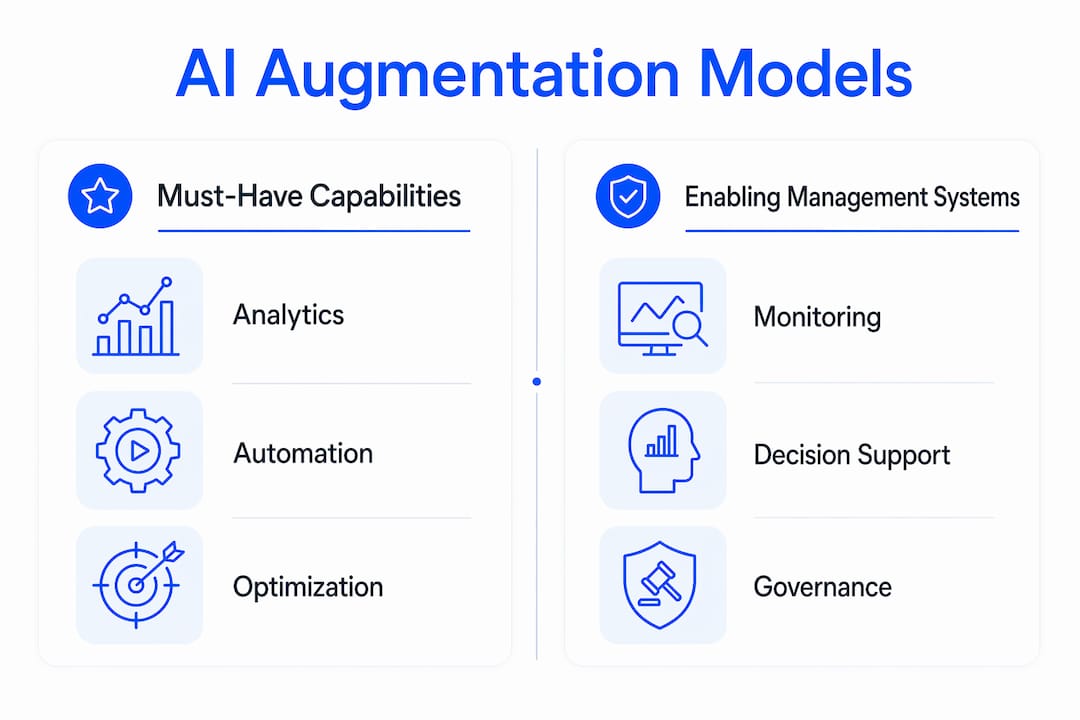
AI strategy must connect technology investments directly to high-impact business outcomes, specifically to “where-to-play” and “how-to-win” choices. That framing is more useful than generic talk about digital transformation.
The table below compares the two augmentation types:
| Augmentation Type | Definition | Business Example | Strategic Impact |
|---|---|---|---|
| Must-Have Capabilities (MHC) | AI enhances the core capabilities that define your competitive position | Netflix AI reshaping content discovery and customer choice | Alters how-to-win strategy; creates differentiation |
| Enabling Management Systems (EMS) | AI improves internal processes that support strategy execution | AI-driven factory scheduling or procurement optimization | Reduces cost and friction; strengthens operational foundation |
| Where-to-Play Expansion | AI opens new markets or business models previously inaccessible | Amazon using recommendation AI to expand into new product categories | Redefines competitive scope and revenue potential |
| Governance and Monitoring | AI replaces status meetings with continuous performance tracking | AI dashboards flagging budget variances and KPI divergences | Shifts leadership focus from data collection to judgment |
The Netflix example is instructive. Netflix did not use AI simply to deliver movies more efficiently. It used AI to change which movies customers choose, which is a fundamentally different strategic move. That is MHC augmentation. A factory using AI to optimize shift scheduling is EMS augmentation. Both create value, but only one reshapes competitive position.
Pro Tip: Map every AI initiative in your portfolio to either MHC or EMS. If you cannot make that connection, the initiative probably lacks strategic alignment and should be deprioritized.
AI augmentation can enhance must-have capabilities and enabling management systems simultaneously, but the strategic intent behind each must be explicit from the start.
What stops AI from delivering strategic value?
The most common reason AI initiatives stall has nothing to do with the technology. AI initiatives often stall because governance and structural design challenges remain unaddressed, not because the algorithms fail. That distinction matters enormously for how you diagnose and fix the problem.
The organizational barriers that consistently undermine AI in business strategy include:
- Data silos. Financial data, operational data, and strategic planning data sit in separate systems that do not talk to each other. AI cannot generate integrated insights from fragmented inputs. Lack of integrated data hampers AI’s strategic impact regardless of how sophisticated the model is.
- Fragmented AI projects. Individual business units launch AI pilots without coordination. Each pilot solves a local problem but contributes nothing to enterprise-level strategic intelligence. Scaling AI across the enterprise needs coordinated strategy and shared data infrastructure, not isolated experiments.
- Weak accountability frameworks. When AI generates a recommendation that turns out to be wrong, who owns that decision? Without clear accountability, organizations either over-rely on AI outputs or ignore them entirely. Neither produces good strategy.
- Ethical and transparency gaps. AI models trained on biased data produce biased strategic recommendations. An effective AI strategy requires ethical deployment, shared data infrastructure, and governance to scale impact responsibly across the enterprise.
- Management processes that have not been redesigned. Most organizations bolt AI onto existing processes rather than rethinking those processes from scratch. The result is AI that generates insights nobody acts on because the decision-making workflow was not built to receive them.
The governance gap is the most underestimated challenge in AI transformation. Technology teams focus on model accuracy. Strategy teams focus on use cases. Nobody owns the structural redesign that makes both useful.
How to embed AI in your strategy: practical steps
Corporate strategists who want to move from AI experimentation to AI-enabled strategy need a structured approach. These four steps reflect what works in practice, not just in theory.
-
Build an integrated data foundation. Strategic planning is evolving toward continuous systems tied with integrated data foundations that enable real-time scenario testing. Connect your financial assumptions, operational constraints, and strategic goals into a single data environment. Without this, every AI tool you deploy will produce partial answers.
-
Align AI tools with specific strategic goals. Generic AI tools produce generic insights. Invest in tools built for your specific strategic questions. AI-powered analytics recommend KPIs based on real organizational data, not generic benchmarks. ClearPoint Strategy, for example, uses AI trained on actual organizational performance data to surface relevant strategic indicators.
-
Embed AI monitoring into governance processes. When leaders approach AI strategically, it replaces status meetings with continuous monitoring that highlights performance divergences requiring leadership attention. Build this into your governance calendar. Replace the monthly data-review meeting with an AI-generated exception report that surfaces only what needs a decision.
-
Train leadership to balance AI insights with human judgment. AI is exceptionally good at pattern recognition and prediction. It is not good at navigating organizational politics, weighing ethical trade-offs, or making judgment calls in genuinely novel situations. The most effective AI-driven decision making combines algorithmic precision with experienced human interpretation. Leaders who treat AI outputs as final answers rather than inputs will make worse decisions, not better ones.
The organizations that get this right treat AI as a capability that augments their strategic process, not a shortcut that replaces it. That distinction separates the companies building durable competitive advantage from those chasing the next technology trend.
Key takeaways
AI delivers lasting competitive advantage in corporate strategy only when it is embedded in governance, grounded in integrated data, and aligned explicitly with where-to-play and how-to-win choices.
| Point | Details |
|---|---|
| AI shifts strategy from periodic to continuous | Real-time monitoring replaces quarterly reviews, enabling faster course corrections. |
| MHC vs. EMS augmentation matters | Map every AI initiative to must-have capabilities or enabling management systems before investing. |
| Governance is the primary barrier | Most AI initiatives fail due to structural and accountability gaps, not technology limitations. |
| Integrated data is non-negotiable | AI cannot generate strategic insight from siloed financial, operational, and planning data. |
| Human judgment remains central | AI augments decision-making; leaders who treat AI outputs as final answers will underperform. |
Why most companies are still getting this wrong
I have watched organizations spend significant budgets on AI tools and walk away with dashboards nobody uses. The pattern is almost always the same. The technology works. The strategy does not.
The fundamental mistake is treating AI as a technology project rather than a management redesign project. You cannot drop a predictive model into a planning process built for annual reviews and expect it to change how decisions get made. The process itself has to change. The meeting cadence has to change. The accountability structure has to change. The technology is the easy part.
What I find most underappreciated is the MHC versus EMS distinction. Most organizations default to EMS applications because they are easier to justify with ROI calculations. Operational efficiency is measurable. Competitive repositioning is harder to quantify. But the companies that use AI to reshape their where-to-play choices, the way Netflix used it to redefine content discovery, are the ones building advantages that are genuinely hard to replicate.
The other thing I would push back on is the idea that more AI means better strategy. Overloading leadership with AI-generated insights without a clear framework for acting on them creates noise, not clarity. The goal is not more data. The goal is better judgment, faster. AI gets you there only if the governance structure is designed to translate its outputs into decisions.
For strategists thinking about where to start, the answer is almost always the data foundation. Fix the silos first. Everything else depends on it.
— BotiqueAI
How Botiqueai helps you build ai-powered strategy
Botiqueai specializes in custom AI solutions designed to move corporate strategy from theory to execution. Whether you need intelligent agents that monitor strategic KPIs in real time, custom automations that connect your financial and operational data, or AI tools built around your specific competitive priorities, Botiqueai builds to your requirements, not to a generic template.
The Botiqueai team has delivered AI-powered strategy solutions for organizations including Pernod Ricard and L’Oréal, demonstrating what tailored AI integration looks like at enterprise scale. If you are ready to move beyond isolated pilots and build AI into the core of your strategic process, explore Botiqueai’s AI solutions to see what a purpose-built approach looks like for your organization.
FAQ
What is the role of AI in corporate strategy?
The role of AI in corporate strategy is to augment decision-making, accelerate data analysis, and enable continuous performance monitoring. AI shifts strategy from periodic planning events to live, adaptive systems that respond to real-time data.
How does AI improve strategic decision-making?
AI improves strategic decision-making by processing large data sets, identifying patterns, and generating scenario models faster than human analysts. Organizations using AI-powered planning tools replace manual data collection with real-time exception reports that focus leadership attention on decisions that matter.
What are the biggest barriers to AI in business strategy?
The biggest barriers are governance gaps, data silos, and management processes that were not redesigned to act on AI outputs. Technology failure is rarely the cause. Structural and accountability challenges are the primary reasons AI initiatives fail to deliver strategic value.
How do i start embedding AI in my organization’s strategy?
Start by building an integrated data foundation that connects financial, operational, and strategic data. Without unified data, AI tools produce fragmented insights. Once the data layer is in place, align specific AI tools to your highest-priority strategic questions.
What is the difference between MHC and EMS AI augmentation?
Must-have capability (MHC) augmentation uses AI to strengthen the core capabilities that define your competitive position, such as Netflix using AI to reshape content discovery. Enabling management system (EMS) augmentation uses AI to improve internal processes like scheduling or procurement. Both create value, but MHC augmentation directly reshapes competitive strategy.